
Analysis
The Two-Strait Crisis: Why Hormuz and Bab al-Mandab Can No Longer Be Treated Separately
Simultaneous pressure on Hormuz and Bab al-Mandab reveals an interconnected maritime system linking Gulf energy, Saudi pipelines, the Red Sea and the Horn of Africa.
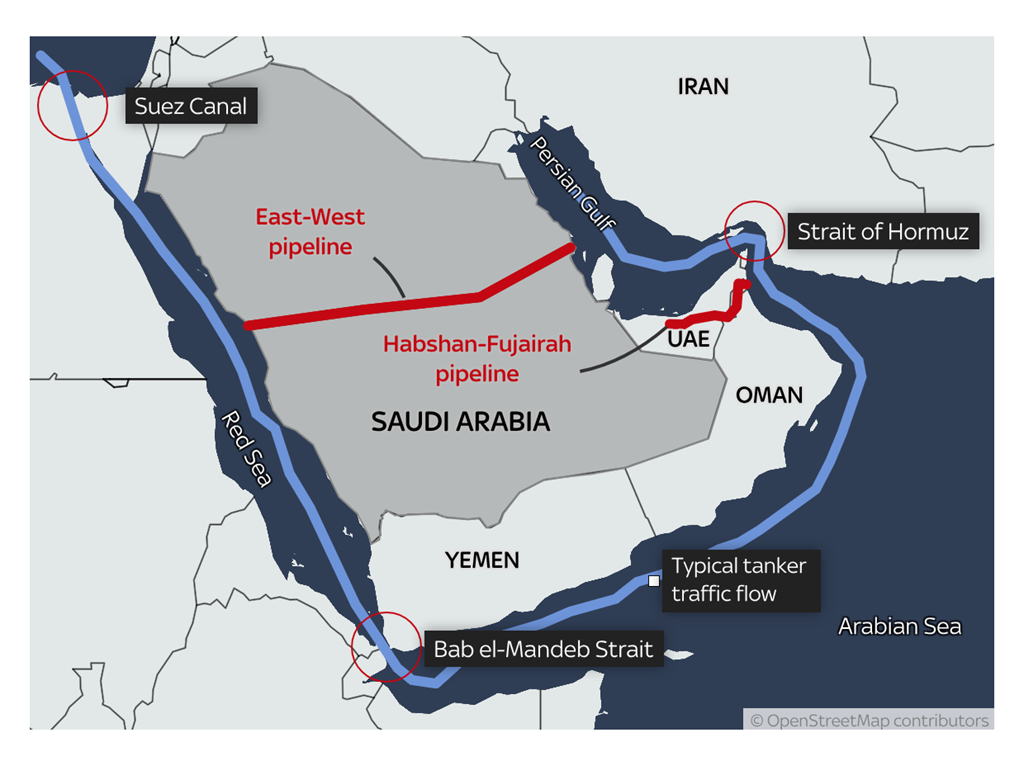
Image credit: via Sky News · Map data © OpenStreetMap contributors
Two of the world’s most important maritime chokepoints are now under pressure at the same time.
Shipping through the Strait of Hormuz has fallen dramatically amid the continuing U.S.–Iran confrontation, while renewed Houthi attacks are threatening commercial traffic through Bab al-Mandab at the opposite end of the Arabian Peninsula.
On August 11, shipping traffic through Hormuz fell to just six vessels, according to Reuters, compared with a pre-war norm of roughly 130 to 140 ships per day. The decline reflects the continuing disruption surrounding the U.S.–Iran conflict and uncertainty over efforts to reach an agreement that could restore normal maritime traffic. [1]
Hours away by sea, another escalation unfolded. A Houthi missile attack struck the Egyptian-owned cargo ship Tihamah near Perim Island in the Bab al-Mandab Strait on August 11, killing four crew members. Two rescuers were subsequently killed when another strike hit during rescue operations. The Houthis claimed that the vessel was carrying Saudi military equipment. [2]
Viewed separately, these appear to be two maritime crises occurring hundreds of miles apart. Strategically, however, they are increasingly becoming one crisis.
From Hormuz to Bab al-Mandab
The Strait of Hormuz and Bab al-Mandab sit at opposite ends of the Arabian Peninsula, but the global energy system connects them.
Hormuz is the principal maritime exit from the Persian Gulf. In 2024 and early 2025, more than one-quarter of globally traded seaborne oil passed through the strait, alongside roughly one-fifth of global liquefied natural gas trade. [3]
Bab al-Mandab performs a different but connected function. Located between Yemen and the Horn of Africa, it connects the Gulf of Aden with the Red Sea and ultimately the Suez Canal. Before the recent Red Sea disruptions, Persian Gulf energy shipments bound for Europe commonly passed through both Hormuz and Bab al-Mandab as part of the same journey. [4]
The geography creates an important strategic relationship. When Hormuz becomes dangerous, Gulf producers search for ways to bypass it.
Saudi Arabia possesses one of the most important alternatives: the East-West pipeline, which carries crude from the kingdom’s eastern oil-producing regions across the Arabian Peninsula to export facilities on the Red Sea.
Saudi Arabia has already demonstrated the strategic value of this system. During previous disruptions around Bab al-Mandab, Saudi Aramco redirected some crude that would normally have moved through Hormuz across the kingdom by pipeline toward Red Sea export terminals. [3]
But this creates another vulnerability. Oil that bypasses Hormuz through Saudi Arabia may still have to confront Bab al-Mandab if it is heading toward Asian markets or leaving the Red Sea southward. The escape route from one chokepoint can therefore increase dependence on another.
Saudi Arabia Sits Between the Two Straits
This makes Saudi Arabia geographically central to the emerging crisis. The kingdom occupies most of the landmass separating the Persian Gulf from the Red Sea. Its pipelines allow energy to move between the two maritime systems without passing through Hormuz.


